
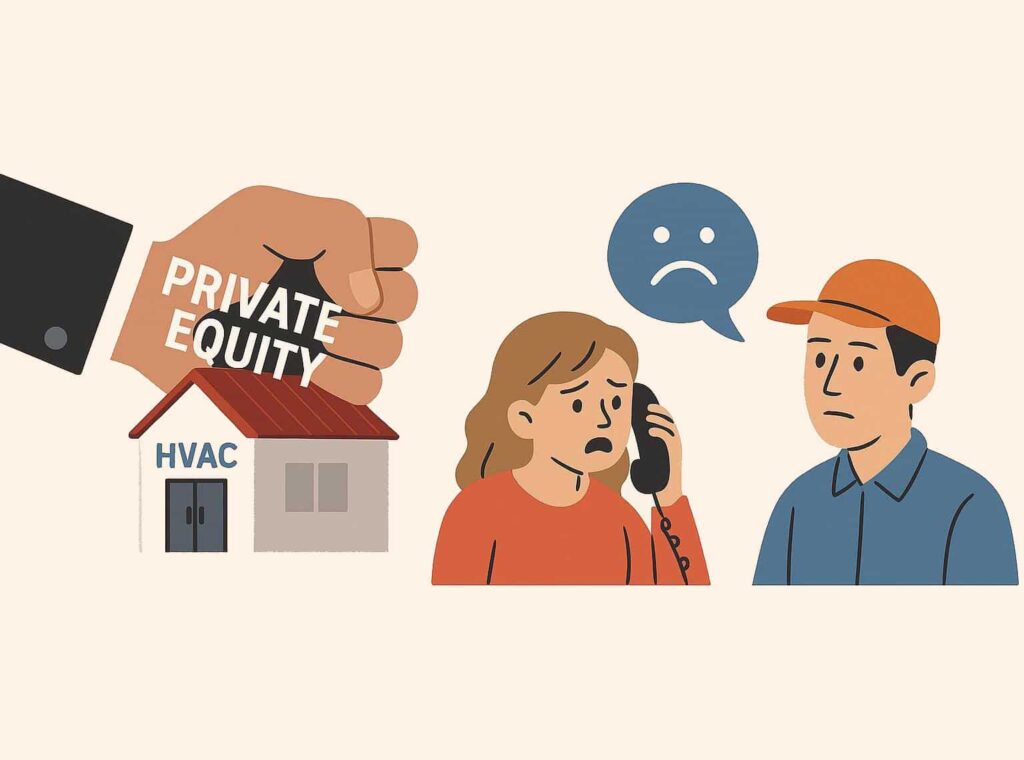
Private equity firms have spent the past several years buying up independent HVAC companies and combining them into larger, investor owned platforms. For Pittsburgh homeowners, that often means higher prices, more aggressive sales tactics, and less consistency in who actually shows up to service their system, which is why knowing who owns your HVAC provider matters more than ever.
Private equity firms are moving quickly into the HVAC industry, replacing independent contractors and family owned businesses with profit driven consolidation. Once focused mainly on tech, finance, and healthcare, investors now see HVAC as fertile ground, fueling growth, driving up prices, pushing aggressive sales tactics, and in many cases eroding service quality along the way.
Is private equity improving HVAC service or hurting it? This article breaks down why investors are flooding the industry, how it’s changing service for Pittsburgh area homeowners, and what you can do to protect yourself.
What Is Private Equity?
Private equity firms invest in or acquire private businesses to generate returns for their investors. US private equity firms are currently sitting on close to a trillion dollars in unallocated capital, and that money puts real pressure on fund managers to deploy it before the investment window closes.
Most private equity firms follow a consolidation strategy, commonly called a rollup. They acquire a platform company and then expand by purchasing and folding in smaller businesses, typically within the same region, so they can scale quickly without building from scratch. When it’s time to sell, the larger combined company commands a higher valuation than the sum of its individual parts, which is where the real return comes from.
Why Is Private Equity Investing in HVAC?
A Recession Resistant Industry With Reliable Cash Flow
HVAC is an essential service. Homeowners depend on their systems year round, and as equipment ages it requires maintenance, repairs, and eventual replacement regardless of the broader economy. That steady, recurring demand is exactly what makes HVAC businesses appealing to investors looking for resilience during downturns.
A Market Full of Small Businesses Means a Big Opportunity for Investors
Small and mid sized independent businesses dominate the HVAC industry nationally, and no single company holds a dominant share, with the largest operators still controlling only a small slice of the overall market. Private equity sees a clear opportunity to streamline operations and build a nationally recognized brand out of a genuinely fragmented sector, and the firms that pull it off stand to profit significantly.
Energy Efficiency Rules Are Changing the Game
Government regulations and consumer preferences are pushing demand toward more energy efficient HVAC systems. Under the EPA’s AIM Act rules, manufacturers were barred from producing new residential air conditioners and heat pumps using R-410A refrigerant starting January 1, 2025, in favor of lower impact refrigerants like R-32 and R-454B. With that kind of regulatory shift underway, private equity firms see an opening to capitalize on the wave of system replacements it drives.
HVAC Is Not a DIY Job, and That Requires Skilled Experts
As HVAC technology advances with smart home integration, automation, and remote monitoring, skilled technicians matter more than ever, not less. Private equity firms can pour money into upgrades and training, which on paper gives them an edge in delivering high tech solutions, though whether that investment reaches the technicians themselves is a separate question.
Built In Revenue From Service Contracts
Planned maintenance and service agreements provide steady, predictable income, which is exactly the kind of built in revenue that makes HVAC businesses attractive for long term investors. If you’re looking for that kind of coverage without worrying about ownership changes down the line, our own seasonal maintenance plan has stayed under the same local ownership since day one.
A Skilled Workforce That Tends to Stay
Unlike many industries with high turnover, skilled HVAC technicians tend to stay in the trade for decades once they’ve found the right employer. Companies that foster a strong workplace culture see meaningfully better employee retention, which increases the underlying value of the business to a buyer.
A Changing Climate Is Straining Equipment and Accelerating Replacements
More extreme heat and more frequent severe weather events put additional strain on HVAC equipment, and industry data shows systems in the hottest climates wearing out noticeably faster than those in milder regions. That accelerated replacement cycle, combined with steady maintenance demand and required upgrades, is part of what makes HVAC an appealing target for consolidation.
How Private Equity Impacts HVAC Companies and Their Customers
Private equity investment in HVAC surged in the early 2020s and has meaningfully reshaped the industry since. Recent tracking shows private equity firms accounting for more than half of disclosed HVAC M&A transactions through mid-2026, a sharp increase from roughly a decade earlier, and current estimates put somewhere around one in ten HVAC businesses with employees under private equity ownership nationally.
Shift in management priorities. When private equity takes over an HVAC company, leadership and strategy often change fast. Experienced operators are frequently replaced with corporate managers focused primarily on quarterly numbers rather than long term service quality.
Customer service takes a backseat to quick profits. Family owned HVAC companies tend to build trust through fair pricing and customer focused service, while private equity backed platforms often prioritize aggressive sales targets. Over time, this shift can erode trust and damage a once solid local reputation.
Rising costs and frustrated customers. Customers grow frustrated with declining service quality, higher prices, and impersonal interactions. As loyalty erodes, more of them start shopping around, which shrinks a company’s repeat business over time.
Skilled technicians leave and service suffers. Private equity cost cutting often means lower wages, reduced benefits, and less job security, which pushes experienced tradespeople toward the door. As those technicians exit, wait times climb and repair quality becomes less consistent.
Less competition can mean higher prices. Private equity buyouts tend to squeeze out smaller, lower cost competitors while backed firms lean on bigger marketing budgets and more aggressive sales tactics. Mid sized independents struggle to compete, and customers often end up paying more for comparable or lower quality service.
Loss of personal service through standardized solutions. Large, investor backed companies often roll out a one size fits all approach that misses the personal touch a smaller, locally run business naturally provides.
Why Private Equity’s Model May Not Hold Up Long Term
What looks good on paper doesn’t always deliver in practice. Most private equity investments are structured to deliver high returns within five to seven years, and that timeline puts real pressure on decision making. High pressure tactics aimed at satisfying investors quickly can come at the cost of business stability, and in some cases lead to real financial trouble for the platform down the line.
How Can You Tell if Your Local HVAC Company Is Private Equity Owned?
It can be genuinely hard to spot when your go to HVAC provider has changed ownership, especially during a period of major transition. These signs tend to be the easiest tells:
- Pay attention to shifts in service quality, pricing, and company policy.
- Watch for staff turnover. A sudden loss of familiar technicians or office staff can signal an ownership change.
- Compare prices and policies over time, including service costs, warranties, and financing terms.
- Stick to your standards, and don’t settle for pushy sales tactics or unnecessary upsells.
- Ask directly whether ownership has changed and how that’s affected day to day operations.
- Share your experience through reviews on platforms like Google Business or Yelp to give other homeowners a heads up.
- Remember you have options, including locally owned companies that prioritize service over sales and look out for their employees and customers alike.
How Can Pittsburgh Homeowners Push Back on Private Equity Consolidation?
Despite their size, private equity firms are not invincible, and customers have more leverage than they might think.
Support local and independent businesses. Spending your money at a locally owned company keeps profits circulating in your own community instead of fueling further consolidation.
Demand transparency. Look into a company’s ownership and decision making structure and support businesses that are upfront about both.
Choose companies that treat people well. Back businesses that pay fair wages, offer real benefits, and prioritize strong customer service over profit driven shortcuts.
Spurk HVAC: Family Owned, Customer Focused, and Built to Last
Since 2018, Spurk AC, Furnace & Boiler Repair proudly serves homes and businesses across the Greater Pittsburgh region, including Cranberry Township, Wexford, Gibsonia, and Mars. We’ve built our reputation on trust, reliable service, quality products, and relationships that last well beyond a single visit. If your current system needs attention regardless of who services it today, AC repair in Pittsburgh and furnace maintenance are both available through our team.
At Spurk, we know private equity backed companies often prioritize profits over people. That’s exactly why we’ve stayed independent, so we can keep offering:
- Trustworthy service built on honesty and reliability.
- Expert technicians who get the job done right the first time.
- Tailored maintenance plans that aim to extend the life of your system.
- Quality equipment and parts for lasting results.
- Financing options that fit your budget without pressure tactics.
Why Choose Spurk HVAC
You deserve better in a world of rising prices, impersonal service, and companies cutting corners to satisfy investors. Experience the difference of working with a company where trust, quality, and customer care still come first. Schedule your service today.
Frequently Asked Questions About Private Equity and HVAC
How do I know if my HVAC company is owned by private equity?
Watch for sudden staff turnover, rebranding, rising prices, or a noticeable shift toward pushy sales tactics after a period of stability. You can also ask the company directly about its ownership structure, since a locally owned business will usually answer that question plainly.
Does private equity ownership always mean worse service?
Not always, but it’s a common pattern. Private equity firms are structured to deliver returns within five to seven years, which tends to push decision making toward short term profit rather than long term customer relationships, even when individual technicians are still skilled and well intentioned.
Why is private equity so interested in HVAC specifically?
HVAC combines recurring, essential demand with a highly fragmented market of small, independent operators, which makes it an ideal target for a consolidation strategy. Steady maintenance contracts and the need for eventual system replacement add a predictable revenue stream that investors find attractive.
Are locally owned HVAC companies more expensive than private equity backed ones?
Not necessarily, and often the opposite is true. Private equity backed platforms frequently carry higher overhead from aggressive marketing and sales structures, which can translate into higher prices for comparable or lower quality service compared to an independent, locally owned company.
What can I do if I don’t want to support a private equity owned HVAC company?
Research a company’s ownership before booking service, ask direct questions about who owns the business, and consider supporting independent, family owned companies in your area instead. Leaving honest reviews about your experience also helps other homeowners make informed choices.