
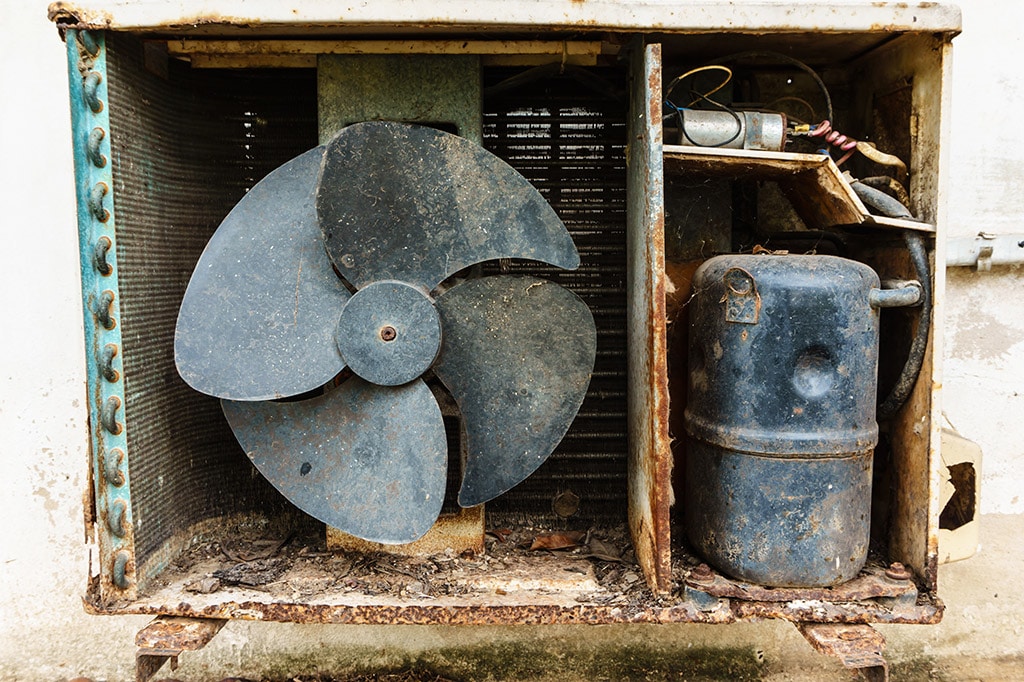
As a rule of thumb, an air conditioner over 10 years old is worth evaluating for replacement, especially if repair costs are climbing or the unit needs refrigerant added. A unit under 5 years old with no history of problems is usually worth repairing instead. Beyond age, cost to operate and repair frequency are the two other factors that matter most.
Gather the Facts Before You Decide
The first thing to do when weighing repair against replacement is gather a few key facts about your specific unit.
How Old Is the Unit?
Since your air conditioner is a mechanical system, age is arguably the most important fact to gather. Could you keep an old car running well past its prime? Sure, for a while, but as parts become harder to find and more expensive, it stops making financial sense. Our rule of thumb is that any unit over 10 years old is worth at least considering for replacement. On the other hand, if your unit is only 5 years old and hasn’t given you any trouble, repair is almost always the better route.
How Much Does It Cost to Run?
Cost to operate is another major factor in the repair versus replace decision. If you’ve started avoiding running your current unit because of what it does to your utility bill, that’s a real sign it may be worth replacing. HVAC technology has advanced quickly in recent years, with variable speed compressors, smart, app-connected thermostats, and mini-split systems like Mitsubishi’s lineup, now controlled through the Comfort app rather than the older kumo cloud branding, all pushing efficiency well beyond what a 10-year-old unit was built to deliver. If your system is over a decade old, it’s worth comparing that efficiency gap directly against a modern AC installation rather than assuming a repair is automatically the cheaper option.
Has the Unit Been a Money Pit With Small Repairs?
How often do you find yourself calling for another repair? If something new goes wrong every year, or every few months, you may be spending more collectively trying to keep the unit running than a replacement would cost outright. Staying current on AC maintenance can stretch a system’s useful life, but once repairs become a pattern rather than an occasional need, that money is usually better redirected toward a new system.
Why Does Refrigerant Type Matter When Deciding?
If an air conditioner needs additional refrigerant, that’s a sign there’s a leak somewhere in the system, not a routine top-off. For older systems still running on R-22, commonly known as Freon, this is where the math gets serious. R-22 production ended in the United States back in 2020, and since the entire remaining supply is reclaimed, prices have continued to climb well past what they were even a few years ago. As of 2026, R-22 typically runs somewhere between $90 and $250 per pound installed, and a full recharge on a residential system can easily run into four figures. Fixing the leak and recharging the system can cost about as much as replacing the compressor outright, and in our experience, once a leak forces us to add refrigerant to an aging system, the compressor tends to be the next component to fail. Repairing a leak, adding refrigerant, and eventually replacing a compressor can add up to roughly the same cost as buying a new unit, without the benefit of a warranty or the efficiency gains a new system provides. Systems installed more recently generally run on R-410A instead of R-22, but that refrigerant is being phased out for new equipment too, so even a system in the 10 to 15 year range is worth evaluating with this in mind.
Making the Right Call for Your Cranberry Township Home
Deciding between a repair and a replacement comes down to weighing your unit’s age, its operating cost, how often it’s needed repairs, and whether it’s still running on an increasingly expensive refrigerant. None of those factors alone gives you the full picture, but together they usually point pretty clearly in one direction. Spurk AC, Furnace & Boiler Repair has spent more than 20 years helping Cranberry Township homeowners make this exact call, and we’re an American Standard Customer Care Dealer and Mitsubishi Diamond Contractor, so we can walk you through the latest options if replacement turns out to be the right move. If the cost of a new system feels like the bigger hurdle, financing options are available to help spread out the investment. Whichever way the facts point for your system, contact our team today and we’ll help you figure out the right next step.
Frequently Asked Questions About Repairing or Replacing an AC
At what age should I consider replacing my air conditioner?
Most HVAC professionals consider 10 years a reasonable point to start evaluating replacement, especially if repair costs are climbing or the system needs refrigerant added. A unit under 5 years old with no history of problems is usually still worth repairing instead.
Is it cheaper to repair or replace an AC that uses R-22?
For most R-22 systems, replacement ends up being the more cost effective choice once a leak is involved, since fixing the leak, recharging the system, and eventually replacing the compressor can add up to close to the cost of a new unit. R-22 prices have also climbed significantly since production ended in 2020, which tips the math further toward replacement.
How do I know if my AC needs more refrigerant?
A system that needs refrigerant added is telling you there’s a leak somewhere, since a properly sealed system doesn’t lose refrigerant over time. Signs include reduced cooling performance, ice forming on the refrigerant lines, and longer than normal run times.
Does frequent repair mean I should replace my AC?
If you’re calling for a repair every year or every few months, the cumulative cost is often higher than simply replacing the unit. A pattern of recurring repairs is one of the clearest signs that a system is nearing the end of its useful life.
Are newer air conditioners really more efficient than a 10-year-old unit?
Yes, HVAC efficiency has improved substantially over the past decade, with modern variable speed compressors and smart controls delivering meaningfully lower operating costs than equipment from even 10 years ago. That efficiency gap is one of the main reasons replacement often makes more financial sense than continuing to repair an older system.